What the Links Mean
Two Ways to See the Connections
The Hyperlinked Bible gives you the same web of cross-references in two complementary views:
- In The Bible (the hub) — connections appear as colored highlights woven into the paragraph text (blue = direct quotation, green = allusion, amber = echo) plus, on OT chapters, colored † crosses at the end of phrases showing where the New Testament cites that OT verse (red = quotation, blue = allusion, green = echo). Click any colored phrase or † to jump to a side-by-side comparison.
- In the Readable Bible (the deep-study verse view) — every verse ends with a row of small inline links: IP, C, TOSK, TT, LT, and on anchor verses, ATN. These give you every connection on a verse, organized by type. This page explains what each abbreviation means, with real examples you can click right now.
If you've never used the site before, start in The Bible and let the colors guide you. If you want the full per-verse cross-reference panel, drop into the Readable Bible. Either view leads to the same underlying content.
Example: Genesis 1:1 in Both Views
Here's the same verse in both views, so you can see what to expect.
The Bible view — paragraph format; colored phrases are clickable links
In the beginning God created [the heavens and the earth]¹.
¹ colored green (Allusion) — clicking this opens an Intertextuality Pair file linking Genesis 1:1 to Isaiah 65:17-18 (the "new heavens and new earth"). A sibling link on the same phrase also ties it to Psalm 104. Blue would mean direct quotation; amber would mean a fainter echo.
Readable Bible view — verse-by-verse; every verse has an inline link row
Genesis 1 . 1
1 In the beginning God created the heavens and the earth. | IP¹ | IP² | TOSK | TT¹ | TT² | TT³ | TT⁴ | LT¹ | LT² |
Each small abbreviation in that row is a link:
- IP¹, IP² — two Intertextuality Pairs (Genesis 1 → Psalm 104; Genesis 1:1 → Isaiah 65:17-18)
- TOSK — the Treasury of Scripture Knowledge entry for this verse
- TT¹ – TT⁴ — four Trajectory Tables this verse feeds (Garden Commission, New Creation, New Jerusalem, New Moons)
- LT¹, LT² — two Longitudinal Themes (Creation and New Creation; Wisdom)
The Bible is where you start reading; the Readable Bible is where you drill into any single verse. Every verse in the Readable Bible has its own anchor (e.g. `Genesis 1 . 1`), so you can link directly to any single verse from anywhere on the site.
The Verse-Number Cascade
The fastest way to remember how to navigate this site: verse numbers always take you one layer deeper. Click (or hover) a verse number anywhere on the site and you drop into the next level of detail.
graph TD
    A["📖 <b>The Bible</b><br/><i>verse #</i>"]
    B["📑 <b>Readable Bible</b><br/><i>verse #</i>"]
    C["🔤 <b>Reference Bible</b><br/><i>each English word</i>"]
    D["📚 <b>Lexicon</b><br/><i>Strong's entry</i>"]

    A ==>|"click / hover"| B
    B ==>|"click / hover"| C
    C ==>|"click any word"| D

    classDef hub fill:#fde8e8,stroke:#c0392b,stroke-width:3px,color:#7b1e1e
    classDef rb fill:#e6edfb,stroke:#1e40af,stroke-width:2.5px,color:#132a75
    classDef ref fill:#e6edfb,stroke:#1e40af,stroke-width:2.5px,color:#132a75
    classDef lex fill:#f8f9fb,stroke:#b8bec8,stroke-width:1.5px,color:#4b5563

    class A hub
    class B rb
    class C ref
    class D lex

    linkStyle 0 stroke:#5b7fd0,stroke-width:3px
    linkStyle 1 stroke:#5b7fd0,stroke-width:3px
    linkStyle 2 stroke:#7aa0d9,stroke-width:2px
So if you're reading The Bible and a verse catches your eye, click its verse number → you're now in the Readable Bible seeing every cross-reference for that verse. Click the verse number again → you're in the Reference Bible seeing the original Hebrew or Greek. Click any word → you're in the Lexicon seeing what that word means.
The other interaction pattern in The Bible is the colored phrases — those are sideways jumps into Intertextuality Pairs (covered in detail below).
† Crosses — How the OT Tells You "the New Testament Cites This"
In OT chapters of The Bible, you'll see small colored † crosses at the end of certain phrases. A cross means: "a New Testament author cites this OT phrase."
The cross system is the mirror image of the colored-phrase system. The colored phrases tell you about Old Testament citations (one OT text quoting, alluding to, or echoing an earlier one). The crosses tell you about New Testament citations of this OT text — and the symbol itself is fitting: the NT's use of the OT all leads, finally, to the cross.
| Marker | Where it lives | What it tells you |
|---|---|---|
| Colored phrase (blue / green / amber) | OT chapters | A later OT author quotes / alludes to / echoes this phrase |
| Colored † (red / blue / green) | OT chapters | A NT author quotes / alludes to / echoes this phrase |
| Colored phrase (blue / green / amber) | NT chapters | This NT phrase quotes / alludes to / echoes an earlier OT text |
The cross color palette
| Cross | Meaning | NT Use of OT |
|---|---|---|
| † | Quotation | An NT author directly quotes this OT phrase verbatim (or near-verbatim) |
| † | Allusion | An NT author clearly references this OT phrase without word-for-word quotation |
| † | Echo | A fainter NT resonance of this OT phrase |
Why crosses exist
The phrase-highlight system shows you connections in the direction the verse was written — an OT phrase highlighted in blue tells you "this exact wording shows up later in the OT."
But many of the most important biblical connections run in the other direction: "Hebrews 1 picks up this exact verse"; "Paul builds an argument on this clause"; "the Gospels structure the passion around this line." The crosses make those NT-uses-of-OT visible from the OT side, so you can read Psalm 22 or Isaiah 53 or Genesis 3:15 and immediately see every place the New Testament reaches back to it.
How to use them
Hover a † to preview the citing NT passage. Click to open the full Intertextuality Pair — the side-by-side text with the connection explained.
A single OT verse may carry several crosses in different colors — one per NT citation. Psalm 110:1, for example, carries roughly 25 crosses (one for each NT citation) — visible evidence of why Psalm 110 anchors so much New Testament Christology.
NT chapters don't have crosses
NT chapters use only the colored-phrase system — because every NT cross-reference is already a use of an OT text, and that OT-citation gets marked as the phrase highlight. There's nothing later in the canon for the NT to look forward to (within Scripture), so no crosses are needed.
Quick Reference — Colors and Link Types
A compact card you can bookmark. Colors live in The Bible (paragraph view); abbreviations live in the Readable Bible (verse view).
| Signal | Where | Meaning |
|---|---|---|
| Blue phrase | The Bible | Direct quotation of another passage |
| Green phrase | The Bible | Allusion — clear and deliberate, but not word-for-word |
| Amber phrase | The Bible | Echo — a fainter intertextual resonance |
| Red † | The Bible (OT only) | The NT directly quotes this OT phrase |
| Blue † | The Bible (OT only) | The NT alludes to this OT phrase |
| Green † | The Bible (OT only) | The NT echoes this OT phrase |
| verse # | Readable Bible | Click the blue verse number to open the Reference Bible (Hebrew/Greek word-level study) |
| IP | Readable Bible | Intertextuality Pair — how this verse quotes or echoes another passage |
| C | Readable Bible | Chiasm — the literary mirror-structure this verse sits inside |
| TOSK | Readable Bible | Treasury of Scripture Knowledge — comprehensive keyword cross-references |
| TT | Readable Bible | Trajectory Table — how this theme develops from OT shadow to fulfillment in Christ |
| LT | Readable Bible | Longitudinal Theme — a canon-wide theological motif traced end-to-end |
| ATN | Readable Bible | Anchor Text Network — every place a specific OT passage gets quoted, alluded to, or echoed across Scripture (appears only on the anchor verses themselves) |
Superscripts: IP¹, IP², IP³ (or TT¹ TT² TT³, C¹ C²) mean multiple of the same type — click each one to see a different connection.
Foundation Texts: deep-exegesis essays on key passages (Hebrew/Greek word studies, full NT-use-of-OT analysis). You reach them by clicking into a Trajectory Table and then clicking a Foundation Text link inside it — they don't appear directly on a verse panel.
Verse Numbers (Blue)
The blue number at the start of each verse is itself a link.
What it does: Takes you to the Reference Bible, where you see every word in the original Hebrew or Greek with its definition.
Example: Click the 1 in Genesis 1:1 and you'll see the Hebrew words bereshit bara elohim — "In the beginning God created" — with links to each word's meaning in the Lexicon.
Who it's for: Anyone curious about what the original words mean. No language training needed — the definitions are right there.
IP — Intertextuality Pairs
What it stands for: Intertextuality Pair — a fancy way of saying "two passages that are connected."
What it does: Shows you how one passage quotes, echoes, or builds on another passage. Biblical authors did this constantly — later writers referenced earlier ones to build the story forward.
Two categories:
- OT to OT — A later Old Testament author referencing an earlier one
- NT to OT — A New Testament author quoting or echoing the Old Testament
What you'll see when you click: The two passages side by side, with an explanation of the connection type and why it matters.
Real Example
Click this link: Matthew 1:22-23 → Isaiah 7:14
Here's what you'll find:
NT Text: Matthew 1:22-23 — "All this took place to fulfill what the Lord had spoken through the prophet: 'The virgin will conceive and give birth to a son, and they will call him Immanuel.'"
OT Source: Isaiah 7:14 — written ~700 years earlier
Connection: Matthew tells you directly — this is a fulfillment. What Isaiah prophesied, Jesus fulfilled. The name "Immanuel" means "God with us," and Matthew uses it as a bookend for his whole Gospel: Jesus is God with us from birth (1:23) to the end of the age (28:20).
When a verse has multiple IPs
You'll see superscript numbers: IP¹ IP² IP³. That means the verse connects to multiple other passages. Genesis 3:14, for example, has three IPs — linking to Isaiah 65:25, Micah 7:17, and Isaiah 25:10.
C — Chiasms
What it stands for: Chiasm (from the Greek letter chi, which looks like an X).
What it does: Reveals a mirror-pattern structure the biblical author deliberately built into the text. Ideas are introduced in order, then repeated in reverse — like a sandwich. The most important idea sits at the center.
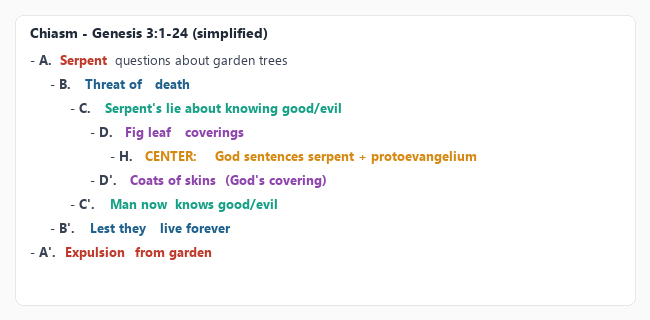
What you'll see when you click: The full structure laid out with indentation and color-coded keywords showing which parts mirror each other.
Real Example
Click this link: Genesis 3:1-24 — The Fall
Here's the simplified structure of what you'll find:
| Element | Content | Mirror |
|---|---|---|
| A | Serpent in the garden | A' |
| B | Threat of death | B' |
| C | Serpent's lie | C' |
| D | Fig leaf coverings | D' |
| E | Hiding from God | E' |
| F | God confronts Adam | F' |
| G | God confronts the woman | G' |
| → H | CENTER: God curses the serpent + promises rescue | |
| G' | God sentences the woman | G |
| F' | God sentences Adam | F |
| E' | Adam names Eve "mother of all living" (faith!) | E |
| D' | God makes coats of skins (first sacrifice) | D |
| C' | Man now knows good and evil | C |
| B' | Lest he eat and live forever | B |
| A' | Expelled from the garden | A |
What does this tell us?
- The center is the point. Moses structured the whole chapter so that God's promise to crush the serpent is literally at the heart of the story.
- The matching pairs reveal meaning. Compare D and D': humans try to cover their shame with fig leaves → God provides real covering through animal skins (the Bible's first death, the Bible's first sacrifice). Human effort vs. God's provision.
- This proves the author intended it. When you see elements in precise mirror positions, you know the writer designed it that way. This isn't our interpretation imposed on the text — it's structure embedded in the text.
TOSK — Treasury of Scripture Knowledge
What it stands for: Treasury of Scripture Knowledge — a cross-reference database compiled by R.A. Torrey in 1897.
What it does: Gives you the most comprehensive set of cross-references ever created — over 500,000 connections. For each verse, TOSK lists every related passage in the Bible, organized by keyword.
What you'll see when you click: A list of related verses grouped by key words and phrases from the verse you're studying.
Real Example
Click this link: Genesis 3:15 in TOSK
Here's a sample of what you'll find:
| Keyword | Connected Passages |
|---|---|
| "enmity" | Numbers 21:6-7, Luke 10:19, Acts 28:3-6 |
| "thy seed" | Matthew 3:7, John 8:44, 1 John 3:8 |
| "her seed" | Isaiah 7:14, Micah 5:3, Galatians 4:4 |
| "it shall bruise" | Romans 16:20, Colossians 2:15, Hebrews 2:14-15 |
Think of TOSK as the ultimate concordance. If you want to know every place the Bible talks about a concept, TOSK will show you.
TT — Trajectory Tables
What it stands for: Trajectory Table — a study that traces how a theme or pattern develops across the entire Bible.
What it does: Shows you how an Old Testament shadow (called a "type") develops through the prophets and finds its fulfillment in Christ (called the "antitype"). It's like watching a seed planted in Genesis grow into a full tree by Revelation.
What you'll see when you click: A table with numbered stages showing the theme's journey from its first appearance through the Old Testament, into the New Testament, and all the way to its final fulfillment.
Real Example
Click this link: Adam (The First and Last Adam)
Here's a simplified version of the 11-stage trajectory you'll find:
| # | Stage | What Happens |
|---|---|---|
| 1 | OT Type — Creation | God creates Adam in his image, gives him dominion (Genesis 1:26-28) |
| 2 | OT Type — The Fall | Adam disobeys, bringing sin and death to everyone (Genesis 3:1-19) |
| 3 | OT Type — Promise | God promises a rescuer who will crush the serpent (Genesis 3:15) |
| 4 | OT Type — Seed Preserved | Seth born to continue the line (Genesis 4:25-26) |
| 5 | Prophetic Anticipation | Psalm 8 asks "What is man?" and describes humanity's intended glory (Psalm 8:4-6) |
| 6 | NT Fulfillment | Jesus is the "Last Adam" — a life-giving spirit (1 Corinthians 15:45) |
| 7 | NT Fulfillment | Where Adam brought death, Christ brings life (Romans 5:12-21) |
| 8 | NT Fulfillment | Jesus crowned with glory through suffering (Hebrews 2:5-9) |
| 9 | NT Fulfillment | All things put under Christ's feet (1 Corinthians 15:27) |
| 10 | NT Fulfillment | Creation itself will be set free (Romans 8:20-21) |
| 11 | Consummation | Satan crushed under our feet (Romans 16:20) |
Each stage links to the actual text in the Readable Bible, and many link to Foundation Texts — detailed analyses with Hebrew and Greek word studies.
The Four-Step Application
At the bottom of every Trajectory Table, you'll find a section called Four-Step Application. This takes the trajectory and makes it personal. Here's how it works, using the Adam trajectory as an example:
| Step | What It Does | Adam Example |
|---|---|---|
| 1. What you must do | States the calling | You must transfer from Adam to Christ — stop trying to save yourself |
| 2. Why you can't | Shows the problem | You can't escape Adam's headship by performing better — your best efforts are tainted by the very corruption you're trying to overcome |
| 3. How He did it | Shows what Christ accomplished | Christ succeeded where Adam failed — perfect obedience, victory over the serpent, restoration of the image |
| 4. How through Him you can | Shows the gospel result | Through union with Christ, His righteousness becomes yours — you're being renewed "after the image of your creator" |
Why this matters: It keeps the Bible from becoming just an academic exercise. Every trajectory — every pattern — leads not just to information about Christ, but to transformation through Christ. The question isn't just "What does this mean?" but "What does this mean for me?"
When a verse has multiple TTs
You'll see superscript numbers: TT¹ TT² TT³. Genesis 3:14 has five trajectory tables connected to it — Adam, New Creation, New Jerusalem, Seed Promise, and Tree of Life. One verse, five threads running through the entire Bible.

LT — Longitudinal Themes
What it stands for: Longitudinal Theme — a theological idea traced from one end of the Bible to the other.
What it does: Similar to Trajectory Tables, but broader. While a TT follows a specific type (like Adam or Passover), an LT follows a big theological idea (like Temple, Covenant, or Kingdom) across the whole canon.
Example: The theme of God's presence with his people runs from Eden (Genesis 3:8) → tabernacle → temple → Jesus ("Immanuel" = God with us) → the church → the new creation ("the dwelling place of God is with man" — Revelation 21:3).
ATN — Anchor Text Networks
What it stands for: Anchor Text Network — a map of the canonical career of one specific OT passage.
What it does: Where a Trajectory Table tracks a subject across Scripture (Adam, Passover, Melchizedek), and a Longitudinal Theme tracks a big idea (Covenant, Kingdom, Temple), an ATN tracks a single OT text — every place it gets quoted, alluded to, recited, or transformed by later biblical authors.
The simplest test: if you can name what you're tracking in three words, it's a TT or LT. If you can only name what you're tracking by its biblical reference (Psalm 110, Isaiah 53:4-6, Exodus 34:6-7), it's an ATN.
Where the link appears: Only on the anchor verses themselves — the actual OT passages whose career is being traced. You won't see an ATN link on, say, Romans 1:17; you'll see it on Habakkuk 2:4 (the anchor) along with a Romans 1:17 citation inside the ATN.
What you'll see when you click: The OT anchor in BSB text, the OT-internal pre-history (where the anchor draws on earlier OT material), the NT verse-by-verse citation (where each NT use is plotted with Greidanus method and Beale category), critical citations flagged, and related TTs and sibling ATNs.
Real Example
Click this link: Psalm 110 — The Right-Hand Session and the Melchizedekian Priest
Here's what you'll find:
The anchor: Psalm 110:1 and 110:4 — "The LORD said to my Lord: 'Sit at My right hand…'" and "You are a priest forever after the order of Melchizedek."
Why this anchors a network: Psalm 110 is the most-cited OT chapter in the New Testament — roughly 25 citations. It anchors three Christological structures the NT cannot do without:
| Anchor verse | Used to argue |
|---|---|
| Ps 110:1 ("Sit at my right hand") | Christ's resurrection-enthronement (Acts 2:34-35; Heb 1:13) |
| Ps 110:1 | Jesus's self-identification at the Sanhedrin (Mark 14:62) |
| Ps 110:4 (Melchizedekian priest) | The entire argument of Hebrews 5-7 — that Christ's priesthood is not Aaronic |
| Ps 110:1 combined | Christ's session as the basis of intercession (Rom 8:34) |
The ATN walks each citation, shows what the NT author is doing with it (direct quotation? typology? composite citation?), and traces the OT-internal warrants (1 Kings 5:3/5/19, Daniel 7:13) that prepared the right-hand-session vocabulary.
Three tiers
Not every OT verse warrants an ATN. The corpus is bounded by citation density:
| Tier | Threshold | Count |
|---|---|---|
| Mega | 15+ NT citations, or structurally load-bearing | 12 |
| Mid | 5-14 citations with OT-internal trajectory + NT culmination | 38 |
| Low | 3-5 citations forming a recognizable network | 26 |
→ Browse all 76 Anchor Text Networks
Multiple Links of the Same Type
When a verse has more than one connection of the same type, you'll see superscript numbers:
- IP¹ IP² IP³ = Three different Intertextuality Pairs
- TT¹ TT² TT³ = Three different Trajectory Tables
- C¹ C² = Two different chiastic structures overlapping
The more links a verse has, the more connected it is to the rest of Scripture. Some verses — like Genesis 3:15 — are major intersections where many threads cross.
→ Next: Try it yourself with a guided walkthrough →
← How the Site Works | Try It Yourself →