Anchor Text Networks vs. Trajectory Tables
How they're alike, how they differ, and a worked example where they overlap
The One-Sentence Distinction
A Trajectory Table (TT) tracks a subject across Scripture. An Anchor Text Network (ATN) tracks a text across Scripture.
If you can name what you're tracking in three words — Adam, Passover, Melchizedek, the Servant — you're tracking a subject. That's a TT.
If you can only name what you're tracking by giving its biblical reference — Psalm 110, Isaiah 53:4-6, Exodus 34:6-7 — you're tracking a text. That's an ATN.
That's the entire methodological difference. Everything else follows from it.
Where They Are Alike
ATNs and TTs share more than they differ. Both are canon-spanning studies that begin in the Old Testament and trace something forward to its fulfillment in Christ. Both are curatorial, not original — they organize connections that published scholars have already identified, not new claims this site is making. Both lean heavily on the same evidentiary base: the Intertextuality Pairs corpus, the Treasury of Scripture Knowledge, Greidanus's seven ways of preaching Christ from the OT, Beale's twelve hermeneutical categories. Both treat the OT as prospective — written with God's authorial intent stretching toward Christ, not merely repurposed by NT readers in hindsight. Both expect readers to work the full chain, not just the endpoints.
The reading experience is similar too. Open either kind of file and you'll find: a header with metadata; an opening paragraph stating the thesis; a numbered table of OT-to-NT stages or citations; a "related" section pointing to neighbors; footnotes flagging where the IPs live. Both end with an exegetical-applicational close.
If you came to a TT and an ATN cold, you might think they were two flavors of the same genre. They are — but the flavor matters.
Where They Differ
| Trajectory Table | Anchor Text Network | |
|---|---|---|
| What it tracks | A subject: a person, event, institution, or pattern | A text: one specific OT verse or short passage |
| Question answered | How does this subject develop across Scripture? | Where does this text show up across Scripture? |
| Naming convention | Subject names — "Adam," "Passover," "Melchizedek (Priest Forever)" | Reference + tag — "Psalm 110 — The Right-Hand Session," "Isaiah 7:14 — Behold the Virgin" |
| Unit of analysis | A theological pattern that can show up under different vocabularies | A specific verbal form whose actual words get reused |
| Inclusion criterion | Conceptual fit with the subject — even if the OT text doesn't share Psalm 110's vocabulary | Verbal contact with the anchor — direct quotation, allusion, or echo of the actual phrasing |
| Where the inline link appears | On every Readable Bible verse that participates in the trajectory | Only on the anchor verses themselves — the original OT passage whose career is being traced |
| Folder | `Trajectory Tables/` (numbered 001–191) | `Anchor Texts/{1 - Mega, 2 - Mid, 3 - Low}/` (76 total, sorted by citation density) |
| Corpus size | ~189 | 76 |
| Tiered? | No — each TT is sized to its subject | Yes — Mega (12, 15+ NT cites), Mid (38, 5-14 cites), Low (26, 3-5 cites) |
| Best for | Preaching/teaching a theme; tracing a type from shadow to substance | Studying a single OT passage's afterlife; tracking the verbal form the NT inherited |
The two genres complement each other because they slice the same data differently. A TT cuts across many texts to assemble a single theme. An ATN sits on one text and watches it travel.
A Worked Example Where They Overlap
The cleanest illustration uses two files that explicitly cross-reference each other in the vault:
- TT: 102 - Melchizedek (Priest Forever)
- ATN: Psalm 110 — The Right-Hand Session and the Melchizedekian Priest
These two files intersect at exactly one verse: Psalm 110:4 — "The Lord has sworn and will not change his mind: 'You are a priest forever after the order of Melchizedek.'" But they treat the same verse from opposite angles, and the difference is instructive.
What the Trajectory Table is doing
The Melchizedek TT asks: Who is this figure, and how does the priest-king pattern he embodies develop across the canon?
So its 12 stages move through the figure of Melchizedek as a typological pattern:
| Stage | Where | What is tracked |
|---|---|---|
| 1 | Genesis 14:18-20 | Melchizedek's first appearance — priest-king of Salem, blessing Abraham |
| 2 | Psalm 110:4 | The prophetic oath constituting Messiah as priest after Melchizedek's order |
| 3 | Psalm 110:1, 4 | The royal-priestly integration of session and priesthood |
| 4 | Zechariah 6:12-13 | The Branch who will be "a priest upon his throne" |
| 5–12 | Hebrews 5-10, Rev 1, Rev 22 | NT exposition of the Melchizedekian priesthood and its consummation |
Notice what the TT includes that has nothing to do with Psalm 110 as a text: Genesis 14, Zechariah 6, Revelation 22. These passages don't quote Psalm 110. They don't even use Psalm 110's vocabulary. But they all participate in the Melchizedek-as-type trajectory — the same theological pattern, traveling under different verbal forms.
That's the TT genre. It collects every passage that contributes to the subject, regardless of whether those passages share verbal form with each other.
What the Anchor Text Network is doing
The Psalm 110 ATN asks: Where does this specific text show up across Scripture, and what happens when it does?
So its citation map is constrained to verbal contact with Psalm 110:
| NT passage | Verse cited | What the NT author does with it |
|---|---|---|
| Matthew 22:44 / Mark 12:36 / Luke 20:42-43 | 110:1 | Jesus presses David's "my Lord" into a Christological puzzle for the Pharisees |
| Mark 14:62 | 110:1 | Jesus's Sanhedrin self-identification: "you will see the Son of Man seated at the right hand of Power" |
| Acts 2:34-35 | 110:1 | Peter's Pentecost climax — Christ's resurrection-enthronement |
| Romans 8:34 / Ephesians 1:20 / Colossians 3:1 | 110:1 | Pauline session theology — Christ seated as basis of intercession |
| 1 Corinthians 15:25 | 110:1 | Christ's reign "until he has put all enemies under his feet" |
| Hebrews 1:3, 1:13, 8:1, 10:12-13, 12:2 | 110:1 | Hebrews' repeated catena of the session as the proof of priestly completion |
| Hebrews 5:6, 7:17, 7:20-22, 7:21 | 110:4 | Hebrews' Melchizedekian-oath argument for a better priesthood |
| 1 Peter 3:22 | 110:1 | Christ at God's right hand, angels and authorities subjected |
Roughly 25 citations. Notice what the ATN excludes that the TT includes: Genesis 14 and Zechariah 6 appear as OT-internal pre-history in the ATN (a brief mention in §3), but they aren't NT citations of Psalm 110, so they don't drive the network. The ATN's spine is the verse-by-verse NT uptake of Psalm 110's actual words.
The ATN also handles a feature the TT cannot — the prosopological puzzle of verse 1. "The Lord said to my Lord…" — David speaking under inspiration calls someone else his Lord. The ATN can dwell on this textual feature because it lives on the verse. The Melchizedek TT cannot, because the prosopological puzzle is a feature of Psalm 110 as a text, not of the Melchizedek figure.
The Venn diagram
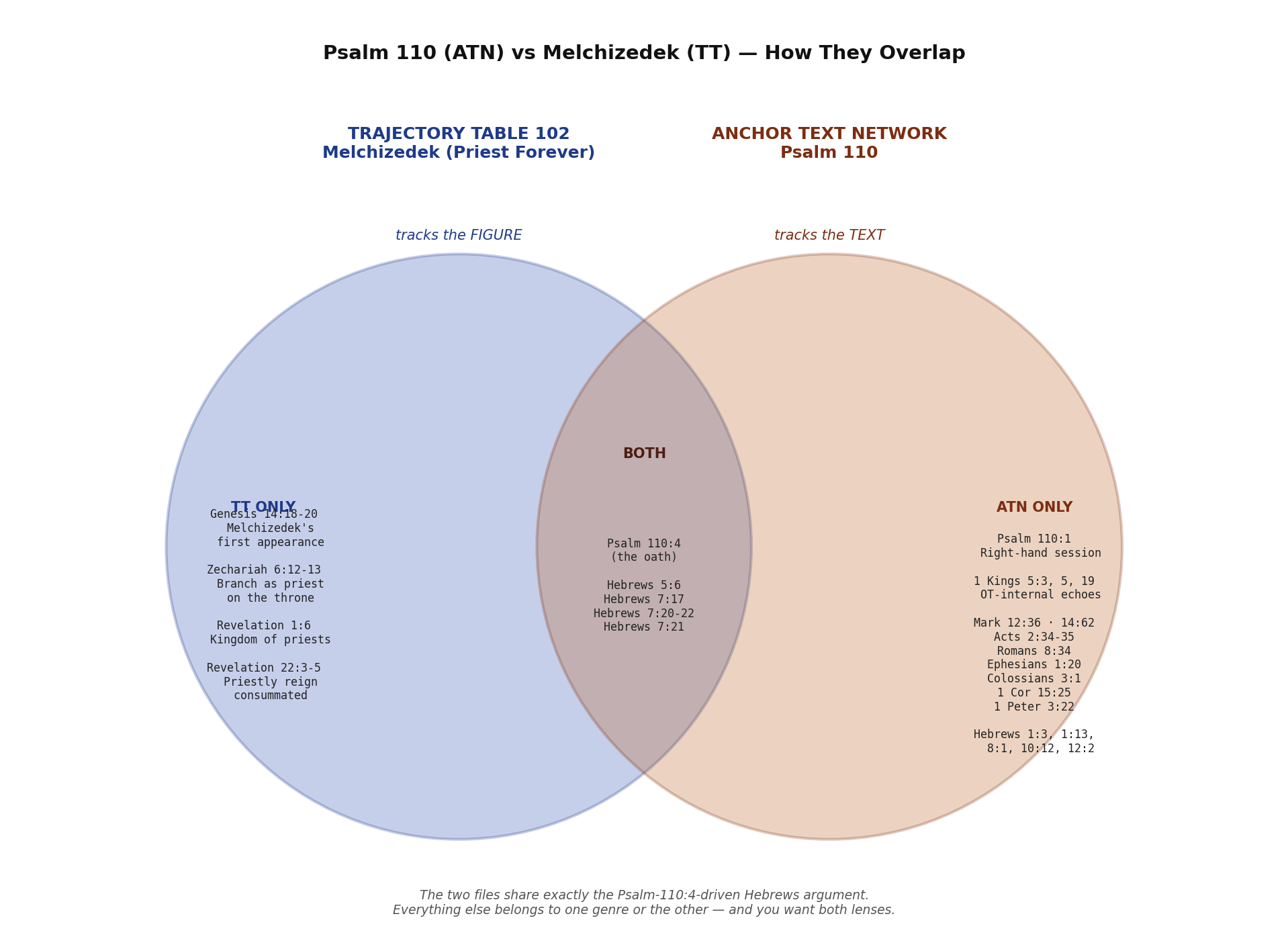
The overlap is exactly the Psalm-110:4 oath argument in Hebrews 5-7, where the NT cites Psalm 110:4 to make a Melchizedekian-priesthood argument. Both files own that intersection. Everything outside it belongs to one or the other.
- TT-only ground is the Melchizedekian pattern's pre-history (Genesis 14:18-20) and post-history (Zechariah 6:12-13; Revelation 1:6; 22:3-5) — passages that participate in the priest-king typology without quoting Psalm 110.
- ATN-only ground is everything the NT does with Psalm 110:1's right-hand session (the largest single bloc of citations in the network — Mark, Acts, Romans, Ephesians, Colossians, 1 Corinthians, 1 Peter, and the Hebrews session-catena), plus Psalm 110's OT-internal echoes in 1 Kings 5.
- The overlap is the small but theologically dense set of Hebrews citations that argue both the Melchizedekian-priesthood theme (TT) and the verse-by-verse use of Psalm 110:4 (ATN).
Why having both matters
Could the Melchizedek TT alone tell the whole story? Almost — but it would have to summarize Hebrews's Psalm-110-driven argument without dwelling on the verse-by-verse text of Psalm 110 itself. It would also have nothing to say about Christ's right-hand session (Psalm 110:1), since session theology is about Christ's exaltation, not about the priest-king type per se. A reader interested in "what does the NT do with Psalm 110:1?" would have to assemble that answer from scratch.
Could the Psalm 110 ATN alone tell the whole story? No — because Melchizedek's typological pattern extends backward (to Genesis 14, which Psalm 110 deploys without expanding) and forward through other texts (Zechariah 6's Branch-priest-on-the-throne, which Psalm 110 doesn't quote). A reader interested in "how does the priest-king type develop across the canon?" would lose the Genesis-Zechariah-Revelation backbone.
You need both. The TT supplies the subject's full canonical arc; the ATN supplies the text's full citation career. They cover the same NT material at the overlap and complementary material everywhere else.
How to Choose Which to Open
Practical heuristic for any given study session:
| If you want to… | Open the… |
|---|---|
| Preach Christ as the better priest from Hebrews | TT — Melchizedek (Priest Forever) |
| Study every NT use of Psalm 110:1 verse-by-verse | ATN — Psalm 110 |
| Trace the priest-king integration from Eden to Eschaton | TT — Melchizedek |
| See why "the LORD said to my Lord" matters Christologically | ATN — Psalm 110 |
| Build a sermon series on Christ-our-mediator | TT — Melchizedek (use Foundation Texts inside it for exegesis) |
| Build a textual study of one passage's afterlife | ATN — Psalm 110 |
| Find every chapter in the Bible that touches the priest-king pattern | TT — Melchizedek |
| Find every NT chapter that quotes/alludes to/echoes Psalm 110:1 or 4 | ATN — Psalm 110 |
When in doubt, start at the TT — it's the broader frame. Use the "Related Anchor Texts" section inside the TT to drop into the relevant ATN(s) when you want to zoom into a specific text's career.
A Compressed Recap
- TTs track subjects across Scripture. Question: how does this theme/figure develop?
- ATNs track texts across Scripture. Question: where does this specific passage show up?
- They overlap wherever a subject's trajectory passes through a specific anchor text — but the overlap is partial. Each genre covers ground the other doesn't.
- Psalm 110 / Melchizedek is the cleanest worked example: the ATN owns Psalm 110:1's session-theology citations and verses 1's prosopological puzzle; the TT owns Melchizedek's pre-history in Genesis 14 and its post-history in Zechariah 6 and Revelation. They meet on Psalm 110:4 and the Hebrews 5-7 oath-of-priesthood argument.
If you're new to the site, the simplest discipline is: start in The Bible (the hub). When a colored phrase pulls you sideways into an Intertextuality Pair, read it. When you want the broader thematic frame, follow the TT link on the verse. When you want to see how the NT works with that specific text, follow the ATN link.
The site has 189 TTs and 76 ATNs precisely because biblical theology requires both lenses. Neither lens alone sees the whole.
Cross-References
- Anchor-Text Networks Methodology — the foundational ATN methodology doc
- Anchor Texts Index — full ATN catalog (76 networks, three tiers)
- Trajectory Tables Index — full TT catalog (~189 trajectories)
- TT 102 — Melchizedek (Priest Forever) — the worked example's TT
- Psalm 110 ATN — the worked example's ATN
- Home Page 04 — What the Links Mean — full link-type and color key
Appendix A — All Anchor Text Networks (76)
Organized by tier. Each link opens the full ATN file.
Mega Tier (12)
15+ NT citations, or structurally load-bearing in major NT argumentation.
- Daniel 7:13-14 — The Son of Man Receiving Dominion
- Deuteronomy 6:4-5 — The Shema
- Exodus 34:6-7 — The Attribute Formula
- Genesis 1:28 — The Adamic Commission
- Genesis 3:15 — The Protoevangelium
- Habakkuk 2:4 — The Righteous Shall Live by Faith
- Isaiah 40:3 — A Voice Crying in the Wilderness
- Isaiah 52:13-53:12 — The Suffering Servant
- Jeremiah 31:31-34 — The New Covenant
- Psalm 2 — You Are My Son
- Psalm 22 — My God, My God, Why Hast Thou Forsaken Me
- Psalm 110 — The Right-Hand Session and the Melchizedekian Priest
Mid Tier (38)
5–14 citations with coherent OT-internal trajectory and NT culmination.
- 2 Samuel 7:12-16 — The Davidic Covenant
- Amos 9:11-12 — The Fallen Booth of David
- Deuteronomy 18:15-19 — A Prophet Like Moses
- Deuteronomy 21:23 — Cursed Is He Who Hangs
- Deuteronomy 30:12-14 — The Word Is Near You
- Exodus 3:6 — God of Abraham, Isaac, and Jacob
- Exodus 12 — The Passover
- Exodus 19:5-6 — A Kingdom of Priests
- Exodus 20 — The Decalogue
- Exodus 24:8 — The Blood of the Covenant
- Ezekiel 36-37 — A New Heart and Dry Bones
- Genesis 1:1 — In the Beginning
- Genesis 2:24 — One Flesh
- Genesis 12:1-3 — The Abrahamic Blessing
- Genesis 15:6 — Abraham Believed God
- Haggai 2:6 — Yet Once More I Will Shake
- Isaiah 6:9-10 — Hearing They Do Not Understand
- Isaiah 7:14 — Behold the Virgin Shall Conceive
- Isaiah 11:1-10 — A Shoot from the Stump of Jesse
- Isaiah 28:16 — A Stone in Zion
- Isaiah 42:1-9 — Behold My Servant
- Isaiah 49:1-6 — A Light to the Nations
- Isaiah 61:1-2 — The Spirit of the Lord
- Isaiah 65:17 — New Heavens and a New Earth
- Joel 2:28-32 — I Will Pour Out My Spirit
- Leviticus 19:18 — Love Your Neighbor
- Malachi 3:1 — Behold I Send My Messenger
- Micah 5:2 — Bethlehem Ephrathah
- Proverbs 3:34 — God Opposes the Proud
- Psalm 8 — What Is Man
- Psalm 16:8-11 — You Will Not Let Your Holy One See Corruption
- Psalm 40:6-8 — A Body You Have Prepared
- Psalm 45:6-7 — Your Throne, O God
- Psalm 68:18 — Ascended on High
- Psalm 69 — The Reproaches
- Psalm 118:22 — The Stone the Builders Rejected
- Zechariah 9:9 — Behold Your King Comes
- Zechariah 12:10 — They Shall Look on Him
Low Tier (26)
3–5 citations forming a recognizable network.
- Deuteronomy 32:43 — Rejoice, O Nations
- Exodus 16 — Manna
- Exodus 17:6 — Water from the Rock
- Exodus 25:8 — Sanctuary Among Them
- Ezekiel 47 — River from the Temple
- Genesis 22:18 — In Your Offspring All Nations
- Genesis 49:10 — The Scepter Shall Not Depart
- Hosea 11:1 — Out of Egypt I Called My Son
- Isaiah 1:9 — Remnant of Sodom
- Isaiah 8:14 — A Stone of Stumbling
- Isaiah 9:6-7 — For to Us a Child Is Born
- Isaiah 52:7 — Beautiful Feet Bringing Good News
- Isaiah 54:1 — Sing, O Barren One
- Jeremiah 7:11 — Den of Robbers
- Job 19:25 — My Redeemer Lives
- Leviticus 16 — The Day of Atonement
- Leviticus 17:11 — Life Is in the Blood
- Numbers 21:8-9 — The Bronze Serpent
- Numbers 24:17 — Star Out of Jacob
- Proverbs 8 — Wisdom Personified
- Psalm 89 — The Davidic Covenant Psalm
- Psalm 95 — Today If You Hear His Voice
- Psalm 102 — Yahweh, You Laid the Foundations
- Psalm 132 — The Davidic Temple Promise
- Zechariah 6:12-13 — The Branch Priest-King
- Zechariah 11:12-13 — Thirty Pieces of Silver
Appendix B — All Trajectory Tables (189)
Numbered TT files in `Trajectory Tables/`. Numbering is non-sequential (176-177 reserved/unused).