
Seven Ways to See Jesus in the Old Testament
The Big Question
How does the Old Testament connect to Jesus? He lived thousands of years after most of it was written. Are we reading Jesus into texts that aren't really about him?
The answer is no — and we're not the ones who came up with this idea. Jesus himself, after his resurrection, walked two disciples through the entire Old Testament — "beginning with Moses and all the Prophets" — and showed them how it all pointed to him (Luke 24:27). The apostles followed his lead, insisting that the Scriptures "bear witness about me" (John 5:39).
But they had guardrails. They didn't find Jesus in random details — they followed real patterns God built into the story. Those patterns travel along seven distinct roads, mapped by Sidney Greidanus in Preaching Christ from the Old Testament. Across this site we call them Greidanus's Seven Ways, and this page walks you through each one.
The Map — Clowney's Square
Edmund Clowney drew a simple square that holds all of this together. Every road from the Old Testament to Christ is a path on it.
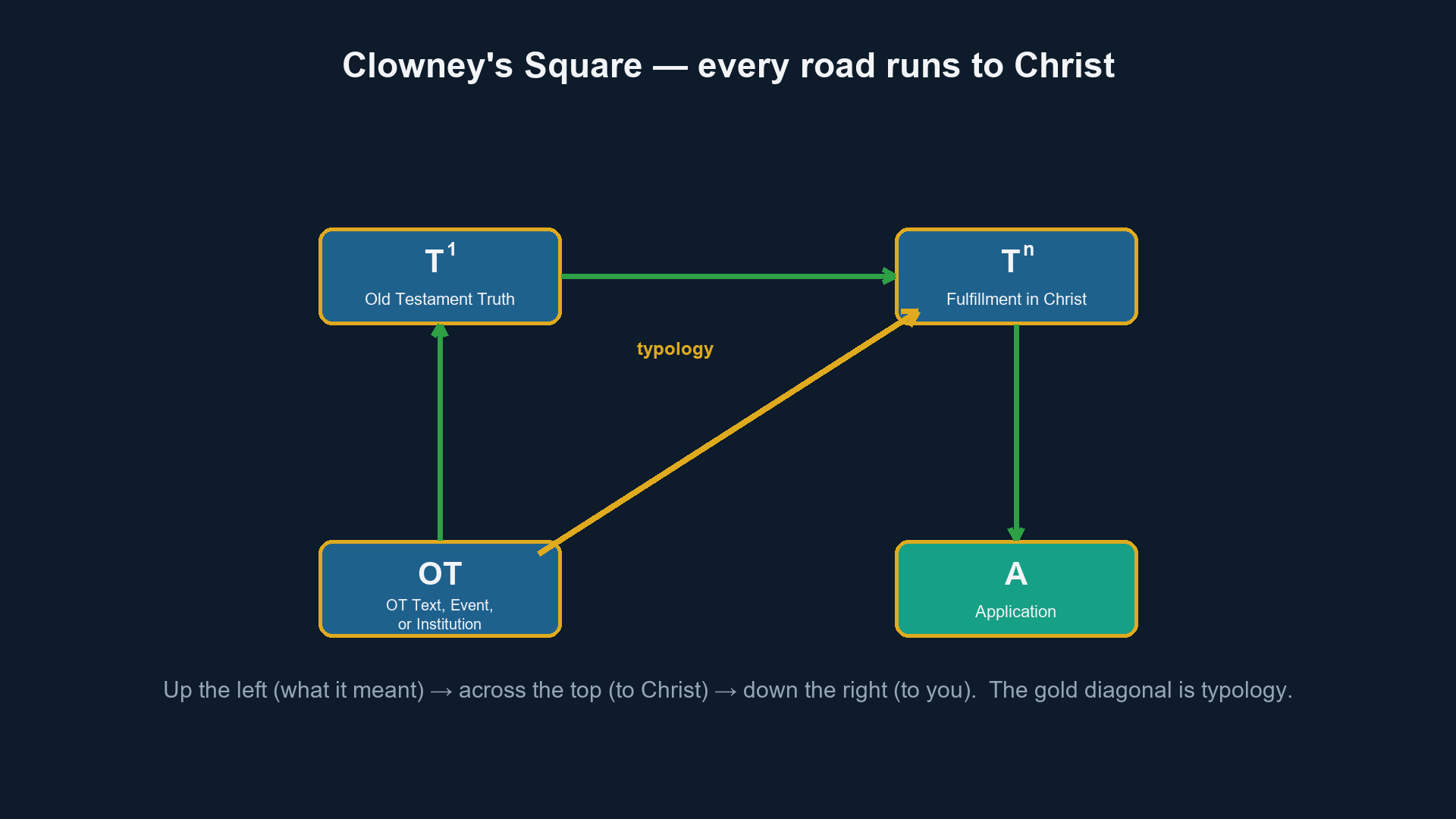
The four corners:
- OT (bottom-left) — the Old Testament text, event, or institution, in its own world.
- T¹ (top-left) — its truth: what it actually meant to its first hearers.
- Tⁿ (top-right) — its fulfillment in Christ.
- A (bottom-right) — the application to us.
The honest road runs the edges: up the left (read what it meant), across the top (carry that meaning forward through redemptive history to Christ), and down the right (apply it — from Christ, never around him). Cutting straight across the middle is where preaching goes wrong — into allegory, forced typology, or moralism.
Here's the key for the seven roads below: most of them are just different ways of crossing the top edge — from the Old Testament's truth (T¹) to its fulfillment in Christ (Tⁿ). Redemptive-historical progression, promise-fulfillment, longitudinal theme, analogy, and contrast all travel that top edge. Typology is the one road that earns the gold diagonal — straight from the Old Testament corner to Christ — because a true type was designed to point forward. (NT references aren't a separate road so much as the New Testament telling you which road a text travels.)
Want the whole thing walked through? Watch the illuminated walkthrough — the six roads that cross Clowney's Square (the seventh, NT references, tells you which road a text travels):
Prefer the short version? The Road to Emmaus overview — why this whole site exists — in a couple of minutes:
The Seven Roads
Road 1: The Story Itself
The Bible tells one story, and that story moves toward Jesus. You don't need to find a coded "connection" in every text — some passages connect to Christ simply by being part of the narrative arc that climaxes in him. The book of Judges, for example, shows Israel spiraling into chaos with the refrain "there was no king in Israel." The story itself is crying out for the king only Jesus can be.
Road 2: Promises Kept
God makes specific verbal commitments in the Old Testament, and Jesus is the one in whom all of them find their "Yes" (2 Corinthians 1:20). A descendant will crush the serpent (Gen 3:15). All nations will be blessed through Abraham's offspring (Gen 12:3). A prophet like Moses will come (Deut 18:15). David's throne will last forever (2 Sam 7:16). A new covenant is coming (Jer 31:31). Jesus keeps them all.
Road 3: Patterns and Previews (Typology)
God designed certain Old Testament people, events, and institutions as previews of what Jesus would do — movie trailers for the main event. The Passover lamb was a preview of Christ, "our Passover lamb" (1 Cor 5:7). Adam was "a pattern of the one to come" (Rom 5:14). The temple was a shadow of Christ's body (John 2:19-21). The key rule: the preview is always smaller than the real thing — what's called escalation. Every TT (Trajectory Table) link on this site traces one of these patterns.
Road 4: Parallel Situations (Analogy)
What God did for Israel, he does for the church — through Christ. God guided Israel with a cloud; Jesus promises "I am with you always" (Matt 28:20). God was Israel's shepherd (Psalm 23); Jesus is the Good Shepherd (John 10:11). Analogy doesn't require that God designed the original as a preview — it simply observes that God acts consistently, and Christ connects us to Israel's story.
Road 5: Big Themes That Run Through the Whole Bible
Major theological themes — temple, covenant, kingdom, sacrifice, God's presence — are introduced early, develop across the centuries, and reach their fullest expression in Christ. Take "God's dwelling with his people": from Eden (Gen 3:8) → the tabernacle (Exod 40:34) → Solomon's temple (1 Kings 8:10) → Jesus, in whom "the Word became flesh and dwelt among us" (John 1:14) → the church as God's temple (1 Cor 3:16) → the new creation where "the dwelling place of God is with man" (Rev 21:3). Every LT (Longitudinal Theme) link traces one of these.
Road 6: The New Testament Says So (NT References)
Sometimes the connection isn't a pattern you have to discern — the New Testament simply tells you. Jesus reads Isaiah 61 in the Nazareth synagogue and announces, "Today this Scripture is fulfilled in your hearing" (Luke 4:21). Paul says of the wilderness rock, "that rock was Christ" (1 Cor 10:4). Hebrews opens by stringing together a chain of Old Testament quotations about the Son (Hebrews 1:5-13). When a New Testament author cites an Old Testament text and points it at Christ, that citation is itself inspired commentary — the Bible's own answer key. This road is the engine of this whole site: every one of the 1,535 NT-to-OT Intertextuality Pairs, and every colored † cross you see on an Old Testament chapter, is a Road 6 connection made clickable.
Road 7: Contrast — What Didn't Work
Some Old Testament realities point to Christ not by resembling him but by failing — showing that something better was needed. The old sacrifices required animals killed over and over because they could never fully deal with sin (Heb 10:1-4). The kings of Israel mostly failed, pointing to the need for a perfect king. The priests sinned and died, pointing to the need for an eternal priest. The law showed what was right but couldn't give the power to do it (Gal 3:24). The Old Testament says, "This isn't working." The New Testament says, "That's because Jesus is the real thing these were pointing to."
How the Seven Roads Work Together
Most passages use several roads at once. Genesis 22 (Abraham and Isaac) uses at least five: it's part of the story, it's a typological preview (only son, sacrificed, "resurrected"), an analogy for God's gift of his Son, a promise fulfilled in "the Lamb of God" — and the New Testament cites it directly, when Hebrews says Abraham "reasoned that God could raise the dead" (Hebrews 11:17-19). The Passover uses typology, promise, theme, and story all at once.
On this site, every Intertextuality Pair and Trajectory Table identifies which road(s) the connection uses — look for the Connection Method(s) field.
Why This Matters
Without these seven roads, you're stuck with only two bad options for reading the Old Testament: moralism ("David was brave, so you should be brave too") or forced allegory ("the scarlet cord represents the blood of Christ"). Greidanus's Seven Ways give you a disciplined framework — they let the text itself determine how it connects to Christ, instead of imposing a meaning on it.
For deeper study of these methods, see How We Read Scripture: Five Foundations, How We Identify a Type (the five tests of valid typology), and Reading Scripture's Use of Scripture (the seven hermeneutical choices). For full theologian-level treatments, see the Scholarly Resources library.
Want to browse the roads in motion? The Greidanus's Seven Ways index classifies every Trajectory Table by the road(s) it travels.
→ Next: The five foundations beneath the seven roads →
← Try It Yourself | How We Read Scripture →
Looking for the audience guide or the book browser? See Who This Is For and the Scripture Index.